Is There Any Better Gift?

Spiritual writer Richard Rohr well sums the significance of Christmas in one challenging sentence:

“Frankly, Jesus came to show us how to be human much more than how to be spiritual, and the process still seems to be in its early stages.”

Jesus’s birth indeed challenges those who celebrate the gift of the Christ Child with the obligation to become a whole new people leading wholly different kinds of lives.

If you kneel dutifully at the manger every December but then leave Bethlehem, head home, and flip over the calendar to January only to resume acting out of control and behaving out of your mind, well then, sorry, but you’ve not properly or fully encountered Christ and his Spirit, and you’ve not faithfully or honestly let Christ and his Spirit take hold of your heart and mind.God comes to us in Christ to inspire a new kind of living that really does reveal we truly do know “the reason for the season.”

Keep those truths in mind as we round off Luke’s telling of the Christmas story this morning.

When Mary and Joseph take the baby Jesus to the temple to dedicate him to God, they encounter a Spirit-filled man named Simeon, who immediately recognizes and celebrates Jesus for who he is. But Simeon also makes some staggering predictions about the destiny of this bouncing baby boy.

A woman named Anna joins in the praise and thanksgiving over the birth of Jesus, and she, too, has high expectation for the Christ Child.

Listen for God’s Word to you this day from Luke 2.

After eight days had passed, it was time to circumcise the child; and he was called Jesus, the name given by the angel before he was conceived in the womb.

When the time came for their purification according to the law of Moses, they brought him up to Jerusalem to present him to the Lord (as it is written in the law of the Lord, “Every firstborn male shall be designated as holy to the Lord”), 24 and they offered a sacrifice according to what is stated in the law of the Lord, “a pair of turtledoves or two young pigeons.”

Now there was a man in Jerusalem whose name was Simeon; this man was righteous and devout, looking forward to the consolation of Israel, and the Holy Spirit rested on him. It had been revealed to him by the Holy Spirit that he would not see death before he had seen the Lord’s Messiah.

Guided by the Spirit, Simeon came into the temple; and when the parents brought in the child Jesus, to do for him what was customary under the law, Simeon took him in his arms and praised God, saying,

“Master, now you are dismissing your servant in peace, according to your word; 30 for my eyes have seen your salvation, which you have prepared in the presence of all peoples, a light for revelation to the Gentiles and for glory to your people Israel.”

And the child’s father and mother were amazed at what was being said about him.

Then Simeon blessed them and said to his mother Mary, “This child is destined for the falling and the rising of many in Israel, and to be a sign that will be opposed so that the inner thoughts of many will be revealed – and a sword will pierce your own soul too.”

There was also a prophet, Anna the daughter of Phanuel, of the tribe of Asher. She was of a great age, having lived with her husband seven years after her marriage, then as a widow to the age of eighty-four. She never left the temple but worshiped there with fasting and prayer night and day. At that moment she came, and began to praise God and to speak about the child to all who were looking for the redemption of Jerusalem.

When they had finished everything required by the law of the Lord, they returned to Galilee, to their own town of Nazareth. The child grew and became strong, filled with wisdom; and the favor of God was upon him. (Luke 2:21-40)

In the United Kingdom, today – December 26 – is called Boxing Day. But the British holiday has nothing to do with two guys duking it out in the ring.

Several centuries ago, it was the custom for tradesmen to collect “Christmas boxes” of money or presents on the first weekday after Christmas as gestures of thanks and tokens of appreciation for good service throughout the year.

This custom of giving linked to an even-older British tradition by which the wealthy gave their servants a day off on December 26, so they could go home and spend time with their families after serving their masters on Christmas Day.

As someone who serves you and our community, I’m going to leverage the Boxing Day tradition by taking part of the morning off and sharing the work of preaching with another.

This, then, is “Is There Any Better Gift?”, a short video created by a YouTuber who goes by the alliterative handle “Dude Dad.”

As a new variant of COVID spreads across the country in the middle of the usual cold and flu season, everyone remains on the high alert for signs and symptoms that you’ve been exposed to something really nasty.

And if we truly hear and take to heart everything that Simeon and Anna are saying, then we also need to be on alert for symptoms that we’ve been exposed to something – someone – gloriously infectious: the Christ Child on whom God’s favor rests.

You and I need to be on alert for signs and symptoms of hope, peace, joy and love invading our bodies, and here are a few things to watch for:

A loss of interest in drama, conflict and judgment.

An inclination to see the glass half full more often than you see it half empty.

A tendency to think and act based less on terror and worry and more on courage and strength.

A preference for letting things happen in God’s good time rather than making things happen on your anxious time.

A desire to seek out the friendship and fellowship of others similarly infected.

A feeling of contentment that comes from being connected to things larger than yourself – the eternal expanse of heaven and the immediate needs of friends, neighbors, and strangers.

Frequent attacks of smiling, and overwhelming moments of appreciation.

Spiking a high fever for forgiveness and reconciliation.

Welcoming newcomers, outcasts, and foreigners and being blessed by the gifts they bring.

Feeding the hungry and finding yourself equally fed by your guests.

Building bridges of trust rather than walls of fear.

Greater openness to the love that others extend along with the uncontrollable urge to extend it yourself.

Can one who comes in so lowly a form –and who ultimately shatters everyone’s fondest hopes by dying on a cross –really manage to infect us like this?

Absolutely!

That answer speaks volumes about the surprising nature of God, and the real work of Christmas that God calls us to do.

Truly, as Dude Dad proclaims, you’re already enough –because the spirit of Jesus in your heart and mind has made you so –but only if you properly and fully encounter Christ and his Spirit, and you’ve faithfully and honestly let Christ and his Spirit take hold of your soul and spirit.

And when that happens – and it will if you let it happen, the gift of your presence will be the best present that anyone can ever receive.

Glory to God in the highest, and on earth peace, goodwill toward all!

Amen, and amen!

Pastor Grant M. VanderVelden shared this message during worship on Sunday, December 26, 2021. Scholarship, commentary, and reflection by R. Allen Culpepper,  L.T. Johnson, and Richard Rohr inform the message.

The Runaway Bunny

Cute little bunnies are more part and parcel of Easter than they are of Christmas. But “The Runaway Bunny,” a children’s story of a young rabbit with a stubborn wanderlust, seems tailormade for understanding why the birth of Jesus is such a big deal.

The story is relatable on a couple different levels. For starters, if you are now or ever were a child, you’ve no doubt experienced being so fed up with what you believed was parental tyranny that you just want to get away from it all. Life under mom and dad’s roof is sometimes just too much for a little kid to bear: The “harsh” oppression of your chores; the “silly” requirement of eating your vegetables; the “ridiculous” rules like being in your bed by 8 p.m. and not getting a cell phone until you’re at least in middle school.

So, you pack up the bare essentials of childhood – your favorite toy, a beloved stuffed animal, and a snack of doubtful nutritional value – and defiantly march out the front door and declare that you’re never coming back.

Whether your destination is a playhouse in the back yard, your best friend’s house, or the fast-food joint down the street, your motivation is the same: Your parents just don’t “get it,” and they’re not being fair.

To punctuate your discontent, you throw in a few harrumphs and some foot-stomps as you trudge down the driveway and up the street into your supposedly newfound freedom to do what you want, when you want – including, but not limited to, staying up late, waking up at noon, and enjoying chocolate cake for breakfast.

To some extent, we’ve all been there – grown-ups included. Even if you never actually follow through on the running away part, you nevertheless experience frustrations that thwart your desire to live your life the way you want to live it – rules, requirements, and respecting the needs of others be damned. You simply want to be the boss of your own destiny – master of your own domain, as it were! One way or another, you wish you could be – or maybe actually are – the runaway bunny.

But at the same time, if you are or were a parent of littles, your empathies are with the runaway bunny’s mother, the other actor in this story. It’s kind of like watching the favorite movie of your teen-age years and suddenly finding yourself rooting for the stressed-out parent who’s struggling to enforce a reasonable curfew.

Here’s the thing, kids:

Somewhere along the line, you’re one day going to realize that most parents aren’t a deliberately oppressive force hell-bent on making your life miserable. Most parents are just trying to use the knowledge they’ve gleaned from their years of life experience to keep you safe and healthy. With age comes, if not astute wisdom, then at least helpful perspective. And most often, your parents do what they do not out of spite but out of love.

If you can’t recognize the motivations and reasoning of the mama bunny, then you can’t understand why the actions of the little bunny are so problematic. But if you don’t remember what it’s like to be the little bunny, then you can’t understand why his choices are a result of childhood’s impulsive nature and why he’s at the mercy of his own risky business. You need both of these insights to begin to see why the mama bunny forgives and pursues her boy in spite of himself.

And in all that, there’s plenty to be gleaned about the life-giving love of God and ever-precious grace of God in Jesus. This, then, is “The Runaway Bunny,” written by Margaret Wise Brown and illustrated by Clement Hurd.

Odds are, if you and I are being brutally honest with ourselves, we’re all guilty of being the runaway bunny. Our sin and brokenness convict us beyond a reasonable doubt.

Be assured, though, that sin and brokenness alone don’t make you a “terrible person.” Sin and brokenness simply make you human, and sin and brokenness rear their ugly heads whenever you and I dismiss God, and disregard what God wants for us, and disrespect what God dreams for us, and discount what God plans for us.

And what’s at once beautiful and terrifying is that God doesn’t stand in the way of all our dismissing, disregarding, disrespecting, and discounting. God doesn’t stop us from running away. Like a shepherd, the Lord doesn’t lock up his sheep to hem them in and prevent them from wandering. He lets us wander – sometimes more than a little. Mama bunny God doesn’t ground her children to keep them at home. God lets us make our own choices, even though the Lord knows full well how oftentimes terrible and ill-conceived those decisions are.

But when we finally let the Holy Spirit take fuller charge of our hearts and minds, and the Spirit tenderly leads us to repentance and lovingly returns us to God, the Lord welcomes you and me back into heaven’s fold with divine arms open wide. God never stops chasing after us – despite the extreme lengths to which we go to get away. And God never ceases to love us – even though our boneheaded determination to do as we please stretches far the boundaries of what makes a person easy to love.

That’s grace in a nutshell!

Grace is one of the strangest, most confusing, yet most wonderful truths of Christian faith. Grace is the free, and unmerited, favor and mercy of God. Free and unmerited! Favor and mercy! None of it based on how well we follow the rules or how robustly we practice our faith. Being given the gift of God’s grace has nothing to do with being well-behaved and obedient. The measure of naughty or nice might work for Santa Claus but definitely not for God.

Grace is mercy and forgiveness, love and kindness, all given without question, to those who haven’t done a blessed thing to earn or deserve it. That’s completely and utterly ridiculous – at least by the standards of the world that claim you only get and deserve what you earn by hard work and the sweat of your own brow.

Grace seems totally and absolutely absurd – unless, of course, you understand the nature of the relationship between the Giver of grace and its intended recipients. Indeed, grace appears wholly and undeniably silly without understanding the roles that you, and God, and Jesus, and the Spirit play in the long-running drama of salvation.

And what happens if you reject God’s gift of grace? If you turn away from grace and scorn the One who gives it? Does the offer expire at midnight like a pre-Christmas flash sale at Target? Does grace wither and die on the vine without an eager, grateful recipient?

Of course not!

Among of its defining and most-precious certainties is this: Grace knows us intimately, as a parent knows a child. And grace pursues us relentlessly and enthusiastically with the energetic excitement and zeal of a puppy playing with an old sock! And a part of us recognizes that fact.

“Where can I go from your spirit?” asks the writer of an Old Testament psalm. “Or where can I flee from your presence? If I make my bed in a deep pit, you are there. If I take the wings of the morning and settle at the farthest limits of the sea, even there your hand shall lead me and your right hand shall hold me fast.”

Put another way, “If you become a rock on the mountain high above me, I will be a mountain climber, and I will climb to where you are,” says mama bunny God. No matter how far, or how long, or how fast we run, God is still there, hot on our heels, offering the gift of grace, and giving us the opportunity to turn in a new direction down a different path.

If you don’t buy that based on the takeaways of “The Runaway Bunny” and the psalm alone, then ponder and step into the Christmas experience of a God who takes on human flesh – a God born in a humble manger bed, in a back alley of a backwater town, with the sole purpose and intention of simply being with us, as one of us, to come to understand firsthand how persistently and malignantly evil tries to lure us away from God and into sin.

If you just can’t wrap your head around the intensity of God’s love for you – and the determination of God’s desires to do something new and different with you and your life, then fast-forward to the Easter experience of a Bethlehem-born God who submits to the pain and humiliation of the Cross to follow you and me even unto death.

God’s quite real pursuit of salvation and redemption for you, me, and all of Creation is intense, powerful, and unrelenting. God’s grace writ large offers the restoration of right relationship with God through Christ and by the Holy Spirit. For without Christmas, there is no Easter. And without Easter, Christmas is just an excuse to deck the halls, wear ugly sweaters, and gorge ourselves on cookies and krumkakka.

Hard as it is to see and accept, that lowly manger bed cradles more than a newborn infant. That manger bed also bears the Cross. But that manger bed also generates the power to roll away a heavy rock from the entrance to a stone-cold tomb.

The grace of Christmas surely has the ability to affect an Easter resurrection that turns your life on a dime from darkness to light in the blink of an eye. That happens sometimes.

But please don’t be overly concerned and fitful if that’s not how quickly and immediately God’s grace is working in your life.

More often than not, grace works more slowly, more patiently, more deliberately. Grace simply asks that you and I stop running and hiding, that we trust in the grace we know in our heart of hearts to forever and always be there. When you realize that you’ve wandered further than you thought, there’s no awaiting shame in that admission. What lies ahead is only mercy, love, and forgiveness. Only grace. Only home. Thanks be to God, the Babe of Bethlehem grows to become the Shepherd who lovingly lays the lost sheep on his shoulders and carries them home.

It is precisely as John declares in his otherworldly Gospel-telling of Jesus’s birth:

“In the beginning was the Word, and the Word was with God, and the Word was God. He was in the beginning with God. All things came into being through him, and without him not one thing came into being. What has come into being in him was life, and the life was the light of all people. The light shines in the darkness, and the darkness did not overcome it. …

“And the Word became flesh and lived among us, and we have seen his glory, the glory as of a father’s only son, full of grace and truth. … [And] from his fullness we have all received, grace upon grace.”

Glory to God in the highest, and on earth, peace, and goodwill toward all. Amen, and amen!

Pastor Grant M. VanderVelden shared this message on Christmas Eve 2021.

Speaking to Suffering

The dramatic events surrounding the birth of Jesus begin to unfold long before the expected cast of characters starts arriving in Bethlehem, and for our discipleship during these Sundays of Advent, Luke’s Gospel has been sharing those miraculous scenes.

Luke’s curtain rises with the archangel Gabriel visiting Elizabeth and Zechariah, an elderly, childless couple who’d long ago given up any hope of becoming parents. Gabriel tells Zechariah that Elizabeth will bear a son. Zechariah is stunned with disbelief, and Gabriel renders Zechariah mute – unable to speak. But Zechariah and Elizabeth are nevertheless overjoyed by Gabriel’s stunning news. God has answered “yes” to their fervent prayers!

A short time later, Gabriel visits one of Elizabeth’s relatives – a teenage girl named Mary, and Gabriel tells Mary that she, too, will bear a son. But becoming pregnant surely is not among Mary’s prayers. Her pregnancy puts her engagement and pending marriage at risk and her very life in peril. Nonetheless, Mary puts her trust in God and opens the whole of her body and soul to the will of God.

Mary then travels to spend a few months with Elizabeth, who by the Holy Spirit recognizes that Mary is carrying God’s promised Messiah. Mary now knows that, too, and she lifts up a lilting prayer of thanksgiving: “My soul magnifies the Lord, and my spirit rejoices in God my Savior, for he has looked with favor on the lowliness of his servant. Surely, from now on all generations will call me blessed; for the Mighty One has done great things for me, and holy is his name.”

In this morning’s Scripture lesson, the time has come for Elizabeth to give birth to her son. After some confusion, the baby is named John. He will grow to become the man we know as John the Baptist, who will prepare the way for the start of Jesus’s earthly ministry. But, for now, just revel in the moment of new life and new birth as you listen for the living, breathing Word of the Lord in the final verses of Luke chapter 1.

Without a doubt, it is a scene filled with great joy. And if you listen carefully, the story also speaks to our suffering.

Now the time came for Elizabeth to give birth, and she bore a son.

Her neighbors and relatives heard that the Lord had shown his great mercy to her, and they rejoiced with her.

On the eighth day they came to circumcise the child, and they were going to name him Zechariah after his father. But his mother said, “No; he is to be called John.” They said to her, “None of your relatives has this name.”

Then they began motioning to his father to find out what name he wanted to give him. He asked for a writing tablet and wrote, “His name is John.” And all of them were amazed. Immediately his mouth was opened and his tongue freed, and he began to speak, praising God.

Fear came over all their neighbors, and all these things were talked about throughout the entire hill country of Judea. All who heard them pondered them and said, “What then will this child become?” For, indeed, the hand of the Lord was with him.

Then his father Zechariah was filled with the Holy Spirit and spoke this prophecy:

“Blessed be the Lord God of Israel, for he has looked favorably on his people and redeemed them. He has raised up a mighty savior for us in the house of his servant David, as he spoke through the mouth of his holy prophets from of old, that we would be saved from our enemies and from the hand of all who hate us.

“Thus he has shown the mercy promised to our ancestors, and has remembered his holy covenant, the oath that he swore to our ancestor Abraham, to grant us that we, being rescued from the hands of our enemies, might serve him without fear, in holiness and righteousness before him all our days.

“And you, child, will be called the prophet of the Most High; for you will go before the Lord to prepare his ways, to give knowledge of salvation to his people by the forgiveness of their sins. By the tender mercy of our God, the dawn from on high will break upon us, to give light to those who sit in darkness and in the shadow of death, to guide our feet into the way of peace.”

The child grew and became strong in spirit, and he was in the wilderness until the day he appeared publicly to Israel. (Luke 1:57-80)

When I served as a chaplain at the University of Iowa hospitals, I was on call one night and got paged to see a patient in the psychiatric unit.

When I arrived in the patient’s room, the young man got right to the point and asked me a question that still haunts me today: “What do you do when you’ve spent most of your life wanting to be dead?”

Um, ya!

I really didn’t have a satisfying answer to his brutally honest question, but I did manage to stammer out a response – something to the effect of, “Clearly, you’ve experienced a lot of pain and heartache in your life. You have emotional wounds that still fester and more than your share of spiritual scars. But you must possess some amazing abilities to endure, because you’re still here. And you’re still fighting, because you reached out to me. Please know that you have my deepest respect. And please know that you’re not alone. Suffering remains part and parcel of our broken and fearful world, and high tides of despair and floodwaters of heartache are inundating countless landscapes where individuals and families live, move, and have their being.”

As with that young man, so also with us: The sources of our pain are varied – grief, shame, and embarrassment; feeling worthless, insignificant, excluded, mocked, and bullied; physical and mental health challenges of seemingly endless color and shade.

And whatever the cause, pain almost always brings with it feelings of vulnerability, isolation, and helplessness – a very real sense of being cut off from those we love and the community around us. When the going gets tough, it’s downright shocking how tempting it is to self-isolate and rob yourself of the very human contact you most need.

Author Viktor Frankl, a survivor of the Nazi death camps of World War II, says that we often cannot control what happens to us in life.

The only thing we can control, he says, is how we respond to those unfortunate events and dark turns of fate when they come crashing down upon us like the ne’re-do-well uncle who shows up uninvited to a holiday party. If we respond to terrible circumstances with tenacity, courage, unselfishness, and dignity, then we can find deeper meaning in our suffering. You can, as it turns out, win small, daily victories over horrific, gut-wrenching circumstances.

Those Nazi camps held many who wanted to die more than live. Mr. Frankl writes that he’d often try to help those who’d given up hope recognize that “life was still expecting something from them; something in the future was expected of them.” He liked to paraphrase philosopher Friedrich Nietzsche: “He who has a why to live for can bear with almost any how.”

That’s surely true in Scripture. The Bible is filled with characters who, at times, are overwhelmed with life and wish they could be rid of it: Moses, Jonah, Elijah, Job. Even Jesus, in the Garden of Gethsemane, pleas with God to spare him the upcoming agony of the Cross. Suffering has such profound and unpredictable effects on these and other characters as it does on all of us. Their misery is so central to the biblical story, because desolation is part of the human experience – part of the bricks and mortar from which we construct our lives.

Without question, suffering makes some people self-centered, loveless, humorless, and angry. But for others, suffering doesn’t so much break them as it does break them open. Suffering transforms them into more caring and compassionate souls – people who are more empathetic, through knowledge and experience, to the suffering of others.

The old saying that we suffer our way to wisdom is spot-on. We often learn more from the hard times than the happy ones – more about ourselves, more about our God, more about how God is always working together unto good – even when evil seems to be running roughshod over everyone and everything.

So, we are right to treat those who have suffered or are suffering with respect and credibility. “Without your wound, where would your power be?” author Thornton Wilder once asked. “It is your very remorse that makes your low voice tremble into the hearts of men,” he wrote. “The very angels themselves cannot persuade the wretched and blundering children on earth as can one human being broken on the wheels of living.” And here, for me anyway, is the microphone-drop: Mr. Wilder writes, “In love’s service, only the wounded soldiers can serve.”

Yet, in searching for places to channel their sometimes-nervous energy, even well-intentioned wounded soldiers misread their marching orders.

A pastoral colleague once told me about a woman with a brain injury who would sometimes fall to the floor. Whenever she’d take a tumble, the good Samaritans around her immediately would rush to get her back on her feet, oftentimes well before she was ready to get up. “I think people rush to help me up, because they are uncomfortable with seeing an adult lying on the floor,” she said. “But what I really need is for someone to get down on the ground with me.”

Getting down on the ground can be anxiety-producing and, when someone is in deep despair, even dangerous to the strongest caregiver. But sometimes, many tmes, you just need to get on the floor. And by your very presence with one who suffers, the fetid swamp of despair and despondence begins draining away to reveal holy ground. And the voice of Zechariah holds tenderly the Good News that is yours, mine and ours:

“Blessed be the Lord God of Israel, for he has looked favorably on his people and redeemed them. He has raised up a mighty savior for us in the house of his servant David, as he spoke through the mouth of his holy prophets from of old, that we would be saved from our enemies and from the hand of all who hate us.”

May it be so, in Jesus’s name, for all those feeling blue, this Christmas, and in the harsh seasons yet to come. Let us get down on the floor and deliver the Good News:  

“By the tender mercy of our God, the dawn from on high will break upon us, to give light to those who sit in darkness and in the shadow of death, to guide our feet into the way of peace.”

Amen, and amen!

Pastor Grant M. VanderVelden shared this message in worship for the fourth Sunday of Advent, December 19, 2021. Scholarship, commentary, and reflection by David Brooks, R. Allen Culpepper, Viktor Frankl, L.T. Johnson, and Thornton Wilder inform the message.

Holy Cow and Zoinks!

For the past two Sundays of Advent, scenes from the first chapter of Luke’s Gospel have been moving us toward Bethlehem and the birth of Jesus. In both scenes, the angel Gabriel has been hard at work bringing incredible news to unlikely recipients.

First, Gabriel visits the AARP-card-carrying Zechariah and Elizabeth and shares the surprising word that the childless couple will indeed receive a son, who will grow to become the man we’ll come to know as John the Baptist. Zechariah and Elizabeth are overjoyed at this incredible news.

Then, a short time later, Gabriel visits a teen-age girl named Mary and announces that she, too, will bear a son. But unlike Zechariah and Elizabeth, becoming pregnant now has not been among Mary’s prayers, for pregnancy actually creates more problems than it solves. She’s not ready for motherhood physically, emotionally, or financially, and in Mary’s day, having a child out of wedlock puts her arranged marriage at risk. It could even get her stoned to death!

But, in spite of the risks to life and limb, Mary responds to God’s call with courage and humility.“Here I am, the servant of the Lord,” she responds to God. “Let it be to me according to your desire.”

This morning, we turn the page to the next scene, which brings these somehow-related mothers-to-be together in one place. Mary travels to Elizabeth’s home, where the two of them catch up and compare notes about the unexpected ways that God is working unto heaven’s good in and through their lives.

It is a family reunion filled with great joy, and Mary lifts up a soaring prayer of thanksgiving that’s quite appropriate for the occasion: “My soul magnifies the Lord, and my spirit rejoices in God my Savior … .”

Listen and be enveloped by the Word of the Lord in Luke 1 starting with verse 39.

In those days Mary set out and went with haste to a Judean town in the hill country, where she entered the house of Zechariah and greeted Elizabeth.

When Elizabeth heard Mary’s greeting, the child leaped in her womb. And Elizabeth was filled with the Holy Spirit and exclaimed with a loud cry, “Blessed are you among women, and blessed is the fruit of your womb. And why has this happened to me, that the mother of my Lord comes to me? For as soon as I heard the sound of your greeting, the child in my womb leaped for joy. And blessed is she who believed that there would be a fulfillment of what was spoken to her by the Lord.”

And Mary said, “My soul magnifies the Lord, and my spirit rejoices in God my Savior, for he has looked with favor on the lowliness of his servant. Surely, from now on all generations will call me blessed; for the Mighty One has done great things for me, and holy is his name.

“His mercy is for those who fear him from generation to generation.He has shown strength with his arm; he has scattered the proud in the thoughts of their hearts. He has brought down the powerful from their thrones, and lifted up the lowly; he has filled the hungry with good things, and sent the rich away empty. He has helped his servant Israel, in remembrance of his mercy, according to the promise he made to our ancestors, to Abraham and to his descendants forever.”

And Mary remained with her about three months and then returned to her home. (Luke 1:39-56)

No prayer is quite as stunning as the one that Mary offers after meeting up with Elizabeth. Her words shake and rattle the foundations of everything we know.

The cosmic events encircling Mary’s life have taught this teen-age girl a thing or two about who God is, and what God is doing, and how God operates.

Mary is well aware of her humble status in her time and place. As much as anything, she’s a piece of property, belonging now to her father and soon to a husband. She doesn’t belong to a famous family, hasn’t grown up in a big city, and has absolutely no prospects whatsoever for making a mark in the world or being remembered for generations.

Yet miraculously and surprisingly, an angel visits her with news from God so stunning, so life-changing, that even the rest of her earthly days won’t provide enough time to understand it all.

Even so, Mary’s reversal of fortune – this lifting up of the lowly, this acclamation of the humble – pieces together a big part of the divine puzzle. Mary connects the dots of the Bible stories she’s heard – about how God singles out another old couple, Abram and Sarai, to begin the covenant; about how God in Genesis forever chooses the younger child over the much-more-highly-regarded older child; about how stuttering Moses, and vulnerable Ruth, and baby-of-the-family David are all called to great leadership.

Mary remembers that God choses Israel for divine favor – not mighty Babylon with its beautiful hanging gardens, not impressive Egypt with its towering pyramids – but lowly little Israel. God choses a bunch of slaves serving under the jack-boot of Pharoah, frees them through parted seawaters, and leads them to a land of promise.

Mary remembers all this and connects all the dots to the child growing in her belly – a child so important that even Elizabeth calls him “My Lord!”

Mary is bearing Elizabeth’s Lord!

She is bearing the Savior of the nations!!

Holy cow and zoinks!!!

God has picked Mary.

Little Mary. Meek and mild.

And as she ponders all this, she connects a few more dots to see that those who, for now, fancy themselves as captains of industry and masters of the universe – those with enough money to cause others to kow-tow to them in one humiliating spectacle after another of sheer servility – these allegedly rich and powerful folks, Mary now knows, are going to be on the losing side of history if, at the end of the cosmic day, their wealth and power are their only comfort in life and in death.

Anticipating words that her son will one day speak, these movers and shakers might have the whole world by the tail, but if in so doing they forfeit their own souls, they’ll one day be sent packing. “What has happened to me is a sign  of what will happen to the whole world one day.”

Mary could see it. Mary sees it with crystal clarity. God loves the poor, favors the disenfranchised, and has keen eyes to spy the invisible members of society. And in the kingdom of that God’s Son, all the wrongs that produce the perpetually poor, and the perennially invisible, and the chronically afflicted will be righted. All the deep wrinkles of illness, and injustice, and suffering will, one day, be completely ironed out in a kind of righteousness that landscapes the whole earth.

Mary prays, “My soul magnifies the Lord, and my spirit rejoices in God my Savior,”because she could see it all.

Can we see this, too?

As Bethlehem inches ever closer – as more candles are lit, as more lights stay on, as more characters begin showing up at the stable, the Advent question that is so properly refreshing, and invigorating, and challenging is this:

“Can we see what Mary sees?”

Can we see that God is still working in the world and in our lives in splendid and unexpected ways?

I surely hope so, because signs and stories abound.

Sometimes a very young child delivers a stunning indictment or a bone-chilling prophecy of some kind, and even though those same words would startle you no matter who said them, it’s the spectacle of a little child uttering those thoughts that makes you hold your breath as you watch and listen.

In these Advent days leading up to Christmas, let the powerful presence of the Holy Spirit stimulate all your senses and help you connect some dots, so you can see what Mary saw – cosmic assurances and life-changing signs that God is doing a new thing in the world –all spoken – like teen-age Mary – through the mouths of babes.

Glory be to the Father, and to the Son, and to the Holy Spirit.

Amen, and amen!

Pastor Grant M. VanderVelden shared this message in worship for the third Sunday of Advent, December 12, 2021. Scholarship, commentary and reflection by R. Allen Culpepper, Scott Hoezee, and L.T. Johnson inform the message. (Artwork: Jen Norton, Canticle of Mary, FineArtAmerica.com)

A Pink Cowboy

Pretend for a moment that a cold winter’s night finds you snuggled into your living-room recliner under a comfy blanket.

And as you surf through the channels on TV, you stumble into the middle of movie. Two cowboys are standing about 30 yards apart in the middle of a dusty street. The men’s hands hang ominously above pistols strapped to their hips. Their steely eyes are locked in glaring glances.

Even though you have no idea what movie this is, you know exactly what’s going to happen – in a split second, their pistols are coming out, and the bullets will start flying. You’re watching the corny formula for a wild, wild west shootout. Even though you weren’t tuned in for the opening credits, the scene itself tells you what you need to know, and you know what’s going to happen next.

It’s tempting to see this morning’s lesson from the Gospel of Luke like that. In a familiar scene we just watched again last week, the angel Gabriel appears to Zechariah and announces that he and his wife, Elizabeth, will finally become parents.

And now this morning, Gabriel appears to Mary and tells her that she, too, will bear a child.

But this isn’t a carbon copy of last Sunday’s scene. We’re not peering in on the OK Corral.

By the power of the Holy Spirit, listen for the word of the Lord and watch for the presence of God, as our journey toward Bethlehem continues, and the next scene in the story of Jesus’s birth unfolds.This is Luke 1, starting with verse 26:

In the sixth month, the angel Gabriel was sent by God to a town in Galilee called Nazareth, to a virgin engaged to a man whose name was Joseph, of the house of David.

The virgin’s name was Mary.And he came to her and said, “Greetings, favored one! The Lord is with you.” But she was much perplexed by his words and pondered what sort of greeting this might be.

The angel said to her, “Do not be afraid, Mary, for you have found favor with God. And now, you will conceive in your womb and bear a son, and you will name him Jesus. He will be great, and will be called the Son of the Most High, and the Lord God will give to him the throne of his ancestor David.He will reign over the house of Jacob forever, and of his kingdom there will be no end.”

Mary said to the angel, “How can this be, since I am a virgin?”

The angel said to her, “The Holy Spirit will come upon you, and the power of the Most High will overshadow you; therefore the child to be born will be holy; he will be called Son of God. And now, your relative Elizabeth in her old age has also conceived a son; and this is the sixth month for her who was said to be barren.For nothing will be impossible with God.”

Then Mary said, “Here am I, the servant of the Lord; let it be with me according to your word.” Then the angel departed from her. (Luke 1:26-38)

Let’s go back to my cowboy-shootout comparison.

Suppose you run across a scene like that while thumbing through the channels.But then suppose that one of the two cowboys is dressed in pink, and when he reaches for his pistol, there’s a flower planted in the barrel.

I’m guessing that such an odd sight would lift your finger off the remote button long enough to see what’s what. There has to be a reason for such an unexpected twist in the usual pattern.

There’s a pink cowboy here in Luke.

An angel visits someone to talk about having a baby. We’ve seen this before. But wait – the mother-to-be is a virgin. Of course she hasn’t had a child yet – at this point, Mary’s probably only 13 or 14 years old, but her becoming pregnant hardly requires a miracle.

Mary isn’t like Sarah of the Old Testament,who was in her 80s when she conceived, or like her relative Elizabeth from last week,who’s near retirement age. No, Mary’s just entered puberty. Something quite new and different is going on.

Cue the pink cowboy. It’s time to sit up and take notice.

Mary understandably asks Gabriel: “How will this be?” But an equally good question to ask is, “Why will this be?”

Mary doesn’t seem like a logical candidate for divine intervention on the fertility front –nor does she seem a likely choice to play a starring role in the divine drama of cosmic redemption. In the society of her day, she’s a real nobody living in a nowhere place. She’s no mover-and-shaker living in a penthouse on Fifth Avenue overlooking Central Park.

Unlike Elizabeth and all the other women in the Bible for whom the announcement of a child is such incredible news, Mary’s not even ready to have a baby! Barely ready physically, hardly ready economically and emotionally! AND, she’s not yet married. Like most girls of her day, Mary’s marriage has been pre-arranged by her parents long ago, so there’s no question that she’ll wed one day; it just hasn’t happened yet.

But an out-of-wedlock pregnancy is reason enough to call off the marriage – it could even get her stoned to death for committing the crime of bearing a child without a husband!

So, “why will this be?”

Gabriel’s big news of impending pregnancy is not the answer to Mary’s prayers like it is for Elizabeth and Zechariah. She isn’t living with the bitter disappointment of being childless. Far from it! Gabriel’s announcement doesn’t so much solve a problem for Mary as it creates a problem. This simply is not the right time for Mary to have a baby!

God has chosen Mary for “favor,” but what a strange “favor” for God to give? God accomplishes for her none of the ideals or goals that so consume daily human striving – wealth, social standing, good health, the best life ever! God’s favored one, Mary, is “blessed” with having an out-of-wedlock child who would later be executed as a criminal, which makes Jesus’s birth as much as scandal as his death.

The ultimate scandal, writes one commentator, is that God would take flesh in the first place and enter human life with all its depravity, violence and corruption. Yet, that’s precisely what God chooses to do. God chooses not to abandon us to suffer the consequences of our sin but rather sends Jesus to us as a deliverer.

The real scandal is that the true essence of God’s “favor” has nothing to do with how acceptable or worthy we are and that God’s blessing often has little to do with making us prosperous or comfortable. God’s favor and blessing are part and parcel of God’s fellowship and relationship with us.

Favor, blessing, fellowship and relationship are bound up together tight as rein – the favor of God with us; the blessing of divine forgiveness and mercy; holy fellowship that transforms us into new creations; trusting relationship that lets God call the shots.

Yes, wrapped up in all that favor, and blessing, and fellowship, and relationship

is the wisdom and courage to be OK with letting God be the director in this scandalous, divine drama that’s playing out before your eyes and to accept with a willing and trusting heart the role that the Lord wants you to play – no matter how hard it is to play the part.

That’s the pink cowboy.

That’s the flower in the barrel.

The baby that finally comes to Zechariah and Elizabeth starts with their hopes, their plans and their dreams.

But this time around, the baby coming to Mary has nothing to do with her timing or her plans and everything to do with God’s timing and God’s plans – AND everything to do God’s mission. God is stepping in this world – upsetting schedules and re-aligning lives, because that’s what it takes to accomplish God’s mission – that of redeeming all of Creation.

And what’s truly amazing is that the people whose schedules and priorities get re-aligned are ordinary, run-of-the-mill people. God chooses the meek and lowly rather than the high and mighty to heal the world of what ails it.

God sends Gabriel not to a queen or a princess – not to Joe Biden or Donald Trump,not to Aaron Rodgers or Patrick Mahomes, but to a girl living in an insignificant and unimportant town and to an ordinary, gray-haired couple doing nothing more than going about their routines of daily life and work. Nothing about Zechariah’s, Elizabeth’s or Mary’s circumstances would lead you to suspect that these common folk have an uncommon role to play in God’s salvation drama. Something very new, very striking, very dramatic, and quite possibly very wonderful is about to happen.

And it is! Pink cowboy. Daisy in the barrel.

Our holiday celebrations might get more real – feel more new, dramatic, striking and wonderful – if we recognized that the glory of Christmas comes about by the willingness of ordinary people – people like you and me – to obey God’s baptismal claim on us and on our lives and to do the things that God would have us do. Unsettling, unexpected, scandalous and scary as it might be, it’s not about our timing or our plans and all about God’s timing, God’s plans, and God’s work.

To some of us, Christmas is all about bringing people together again, especially those who are estranged from each other.

Our favorite holiday movies reach their climax when the mom and dad who’ve been fighting get back together and avoid divorce.

Scrooge wakes up a changed man.

The Grinch’s heart grows larger and more loving.

The whole town of Bedford Falls shows up to save the day for George Bailey.

The next-door neighbor in “Home Alone” re-connects with his son.

Through it all, the spotlight of Christmas shines on us. So after a while, we start to think that having a “good Christmas” means being a little nicer than usual, maybe patching up a broken relationship or two, digging a little deeper into our pockets to chip in to a charity or two, and just generally getting along with everyone so as not to lay a wet blanket on all the holiday cheer.

“Peace on earth” may or may not happen in any literal sense, so we settle for the “peace” of not having Uncle Charlie and cousin Edna spew looney-tune conspiracy theories at the Christmas dinner table like last year.

We’re not really looking to change the world – we’ll just settle for getting along with some sense of reasonable happiness and tranquility until January 2nd mercifully arrives and we can get back to normal – however dysfunctional, and unholy, and self-centered normal might be.

In other words, we make Christmas about us – about solving our problems, about finding ways to handle this or that difficulty in our family dynamics.

At least some such concerns aren’t bad things to think about or work on, but they’re nowhere near the core of Advent’s lead-up to Christmas. Christmas isn’t first of all about we want. As with Mary, so with us: the Lord brings us what he knows we need whether we think we need it or not.

God intervenes in our lives to remind us that what Advent is about is the defeat of sin, evil, and death and about being ready to take on the difficult, potentially embarrassing, and possibly scandalous jobs that the Lord calls us to do, so that God’s mission continues.

The advent of God’s Christ into this world –as Gabriel’s speech to Mary makes so crystal clear –is ultimately about so much more than the seven-layer salad or rum balls you bring to the Christmas buffet or the ugly sweater you can’t wait to bring to the return counter.

Christ is the pink cowboy brandishing a flower that should stop you in your tracks long enough to notice that God is doing a new thing in your life and in the world, and it takes Mary-like courage to accept the blessing of Emmanuel –“God with you, God with us” – because sometimes that blessing creates Mary-like problems.

Given that all things are possible with God, it’s possible that God wants to do some great things through you – however impossible or improbable that sounds, for that just is the way that God works.

For that just is the Word of the Lord. Thanks be to God!

Pastor Grant M. VanderVelden shared this message in worship for the second Sunday of Advent, December 5, 2021. Scholarship, commentary and reflection by R. Allen Culpepper, Scott Hoezee, and L.T. Johnson inform the message.

Even in a Broken World

Our journey to Bethlehem and the birth of Jesus begins this first Sunday of Advent with the Gospel of Luke and the story of a faithful, long-serving priest named Zechariah and his wife, Elizabeth.

For years, Zechariah prays anxiously for the birth of a son only to get back what he hears as a great-big “no.” With days of youth now just a faint speck in his rear-view mirror – and Elizabeth now well past her child-bearing years, Zechariah had long ago stopped being ready for his heartfelt prayers for a son to be answered with a resounding “Yes!”

And so, Zechariah resigns himself to the daily routine of his priestly duties, knowing that the family lineage of priesthood ends with him, and he never really expects to experience the presence of God – even in the holy moments of being in the holiest of places, the inner Sanctuary of the temple, where he and the rest of his congregation believe that God resides.

Listen, now, with all your senses, for the Word of the Lord at the start of Luke’s Gospel.

In the days of King Herod of Judea, there was a priest named Zechariah, who belonged to the priestly order of Abijah. His wife was a descendant of Aaron, and her name was Elizabeth.

Both of them were righteous before God, living blamelessly according to all the commandments and regulations of the Lord. But they had no children, because Elizabeth was barren, and both were getting on in years.

Once when he was serving as priest before God and his section was on duty, he was chosen by lot, according to the custom of the priesthood, to enter the sanctuary of the Lord and offer incense. Now at the time of the incense offering, the whole assembly of the people was praying outside.

Then there appeared to him an angel of the Lord, standing at the right side of the altar of incense. When Zechariah saw him, he was terrified; and fear overwhelmed him. But the angel said to him,

“Do not be afraid, Zechariah, for your prayer has been heard. Your wife Elizabeth will bear you a son, and you will name him John. You will have joy and gladness, and many will rejoice at his birth, for he will be great in the sight of the Lord. He must never drink wine or strong drink; even before his birth he will be filled with the Holy Spirit. He will turn many of the people of Israel to the Lord their God. With the spirit and power of Elijah he will go before him, to turn the hearts of parents to their children, and the disobedient to the wisdom of the righteous, to make ready a people prepared for the Lord.”

Zechariah said to the angel, “How will I know that this is so? For I am an old man, and my wife is getting on in years.”

The angel replied, “I am Gabriel. I stand in the presence of God, and I have been sent to speak to you and to bring you this good news. But now, because you did not believe my words, which will be fulfilled in their time, you will become mute, unable to speak, until the day these things occur.”

Meanwhile, the people were waiting for Zechariah, and wondered at his delay in the sanctuary. When he did come out, he could not speak to them, and they realized that he had seen a vision in the sanctuary. He kept motioning to them and remained unable to speak. When his time of service was ended, he went to his home.

After those days his wife Elizabeth conceived, and for five months she remained in seclusion. She said, “This is what the Lord has done for me when he looked favorably on me and took away the disgrace I have endured among my people.” (Luke 1:5-25)

Over time, the expectations of even the most faithful and dedicated of disciples can become dull and lifeless.

Each of us experiences our own Zechariah-like seasons of hopelessness, resigned to spend our days and weeks going through the motions of worship and prayer but hardly expecting to meet God in the midst of daily life. 

With days growing shorter and colder – the earth around us becoming hard as iron, the sky above us turning gray, the fierce north wind starting to howl through the cracks of the places where our hearts dwell, our instinctive tendency is to set the bar of expectation Zechariah low and to hunker down into physical, emotional, and spiritual hibernation – our long winter’s nap made fitful and restless by holiday stress, family tension, and worries of everyday life made even more anxious by ever-more-heartbreaking and disappointing headlines in the news.

And really, why should we set high the bar of expectation? Stores and TV commercials remind us by the minute of what needs to get “done” for the holidays, and our expectation in all that “doing” is plenty of frustrating hustle, bustle, and hassle as we prepare the “perfect” family celebration,  decorate the “perfect” tree, and make endless shopping trips to find the “perfect” gift at the “best” price.  The to-do list spins endlessly out of control.

Try as we might to keep Christ in Christmas, the reality of our Advent season is dull and lifeless expectation of the same ol’ same ol’ – daily life as chaotic and crowded as a shopping mall on Black Friday.

To expect anything better seems, well, pointless, since like Zechariah, God still seems to be sending out a lot of great-big “no’s.” No real change, no real hope. Illness and brokenness still holding sway. Precious few swords being beaten into plowshares. Suspicion, negativity and pessimism our natural reflex. Trust and hope a tattered figment of the past. Plenty of modern-day Zechariahs and Zecharinas letting out weary sighs of continued misery – the will and desire to find assurance in God’s promises of a better tomorrow all but spent and exhausted. The eyes of God’s people so red and puffy from daily tears that they cannot see God present in their midst, let alone have the energy to even look for God amid all the clutter that fills desk, countertop, backpack, barn and garage.

As Yogi Barra once remarked: “The future ain’t what it used to be.”

A remarkable French film, Joyeux Noel, offers a melodic vision of what the world could be like if only God’s promises made flesh in the wombs of Elizabeth this morning and Mary next Sunday could indeed lead the way toward peace.

The film tells a true story from World War I, when trench warfare brings soldiers from opposing sides into close proximity.  The daily routine of trench warfare leads to some of the most sickening slaughters that anyone’s ever seen. The staggering losses among the British alone lead Winston Churchill to say afterward that theirs is a victory “scarcely indistinguishable from defeat.”

But on one particular battlefield on Christmas Eve 1914, the closeness of the trenches leads to something very different.  In the German trenches, a soldier and talented tenor tries to lift the spirits of his fellow Germans by belting out a hearty rendition of “Stille Nacht” (“Silent Night”).   Just as he is about to begin the second stanza, his comrades are startled by the sound of a bagpipe player taking up the tune in the nearby Scottish trench. The singing continues until finally the tenor and the bagpiper pop up from their respective trenches to face each other.

When the bagpiper starts to play “Adeste Fideles” (“O Come, All Ye Faithful”), the German tenor takes up the song, and the bewildered Scottsmen begin to sing along.  Finally, all the soldiers emerge for an impromptu Christmas Eve ceasefire, singalong, and celebration – sharing chocolate, champagne, brandy, and other treats; reveling for a time in their shared humanity; and putting aside the war that makes it their primary duty to kill each other.

When we come together to the holy mountain of our God and to God’s Christ, surely it will be true – just as the prophet Isaiah predicts: They will learn war no more and walk in the light of the Lord. Sometimes, you can see glimpses of that – even in a broken world.

Yes, indeed! In spite of the tumult of war – in spite of conflict and division between friend, neighbor and stranger, God’s Advent promise is being fulfilled in our midst. It is time – God’s time, and God’s time is here. God’s promises can be seen on the cross, in the waters of baptism, and in the bread and wine of the Lord’s Table.

Yes, indeed! God has given us divine shoulders on which to lean. God has already given us the courage we need to get through and beyond whatever turmoil a broken and fearful world throws at us. When all we hear is God giving us a great-big “No! Period,” God is actually giving us a “No, comma, not yet!”

So, hang in there, Zechariah! The son you’ve been praying for is on his way!! Hang in there!!! Hang in there, people of God, for God has claimed you by name.  His Christ has come for you! And his Christ is coming back for you! Hints and signs of that great day to come have already begun to appear! God’s perfect plan of salvation is happening now, and even in a broken and fearful world, we have reason to celebrate those glimpses of the coming days that are already here! Let that hope and assurance – borne of God’s Holy Spirit in Christ – see you through any  darkness hanging over your holidays and weighing heavy on your hearts.

In the words of a confession of the Presbyterian Church:

“In a broken and fearful world, the Spirit gives us courage to pray without ceasing, to witness among all peoples to Christ as Lord and Savior, to unmask idolatries in Church and culture, to hear the voices of peoples long silenced, and to work with others for justice, freedom, and peace.

“In gratitude to God, empowered by the Spirit, we strive to serve Christ in our daily tasks and to live holy and joyful lives, even as we watch for God’s new heaven and new earth, praying, “Come, Lord Jesus!

“With believers in every time and place, we rejoice that nothing in life or in death can separate us from the love of God in Christ Jesus our Lord.

“Glory be to the Father, and to the Son, and to the Holy Spirit. Amen, and Amen.”

Pastor Grant M. VanderVelden shared this message in worship for the first Sunday of Advent, November 28, 2021. Scholarship, commentary and reflection by R. Allen Culpepper, Scott Hoezee, and L.T. Johnson inform the message.

The Power of Your Story

If you worship with us regularly, then you know that I always begin our Sunday services with a question: How has God been working in your life this past week?

And I’m always grateful when a few brave souls share a story about a “God moment” that they experienced.

I’m grateful because your stories of encountering the Lord are powerful. Sharing your stories of how you experienced God working in your life are your testimonies to the honest-to-goodness truth that the Lord is alive and well, and dwelling among us, and working unto good in the midst of all things. Sharing your stories of God’s grace flowing into your lives provides hope and assurance to others who just might be wallowing in places of hopelessness and doubt. Sharing your stories of the Lord’s very-real presence in your life might just end up changing the outlook and course of someone else’s life.

The power of story is on full display in this morning’s Scripture lesson from the book of Acts, which drops us in the middle of a tense encounter between the apostle Paul and an angry crowd. The Roman authorities have just saved the Paul from an unruly mob of Jews in Jerusalem who’ve physically attacked him and accused him of breaking ranks with Jewish faith.

As the authorities carry the injured Paul to safety, he asks to speak to the angry crowd in hopes of defending his beliefs and actions – his belief in Jesus Christ as the Savior that God promised to send to the Jews, and his actions of spreading the Good News of the Gospel to – of all people – the reviled Gentiles.

A Roman official grants Paul’s request to speak, but Paul doesn’t preach a grand sermon. He simply shares his story – the story of his conversion from being a nasty, mean persecutor of Christ’s followers to becoming one of them. Listen with all your senses for the living, breathing Word of the Lord.

When the Roman official had given him permission, Paul stood on the steps and motioned to the people for silence; and when there was a great hush, he addressed them in the Hebrew language, saying:

“Brothers and fathers, listen to the defense that I now make before you.” When they heard him addressing them in Hebrew, they became even more quiet. Then he said: “I am a Jew, born in Tarsus in Cilicia, but brought up in this city at the feet of Gamaliel, educated strictly according to our ancestral law, being zealous for God, just as all of you are today. I persecuted this Way up to the point of death by binding both men and women and putting them in prison, as the high priest and the whole council of elders can testify about me. From them I also received letters to the brothers in Damascus, and I went there in order to bind those who were there and to bring them back to Jerusalem for punishment.

“While I was on my way and approaching Damascus, about noon a great light from heaven suddenly shone about me. I fell to the ground and heard a voice saying to me, ‘Saul, Saul, why are you persecuting me?’’ I answered, ‘Who are you, Lord?’ Then he said to me, ‘I am Jesus of Nazareth whom you are persecuting.’

“Now those who were with me saw the light but did not hear the voice of the one who was speaking to me. I asked, ‘What am I to do, Lord’ The Lord said to me, ‘Get up and go to Damascus; there you will be told everything that has been assigned to you to do.’ Since I could not see because of the brightness of that light, those who were with me took my hand and led me to Damascus.

“”A certain Ananias, who was a devout man according to the law and well spoken of by all the Jews living there, came to me; and standing beside me, he said, ‘Brother Saul, regain your sight!’ In that very hour I regained my sight and saw him. Then he said, ‘The God of our ancestors has chosen you to know his will, to see the Righteous One and to hear his own voice; for you will be his witness to all the world of what you have seen and heard. And now why do you delay? Get up, be baptized, and have your sins washed away, calling on his name.’”(Acts 21:40-22:16)

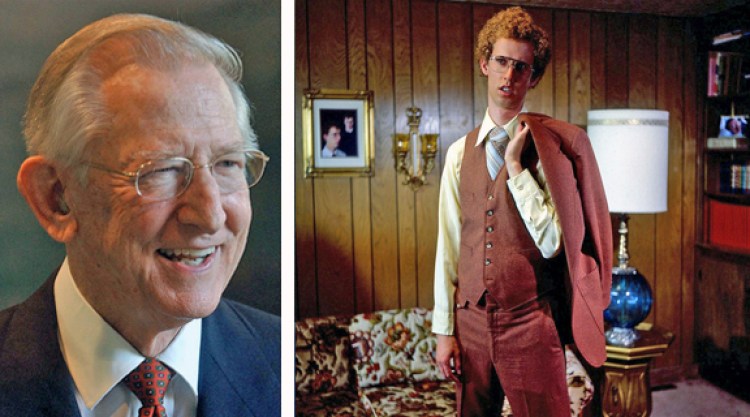
Age may determine whether you know who these guys are.

If you’re younger, you’ll likely recognize the guy on the right as Napoleon Dynamite, the “hero” in the movie of the same name. Napoleon Dynamite doesn’t fit in anywhere. He is the nerdiest, geekiest, drippiest kid you’ll ever meet –frizzy-haired, buck-toothed, thickly-bespeckled, gangly built, and so socially awkward that it’s painful to watch him try to interact with others. Napoleon is the very essence of the agony of not fitting in – of being that square peg of a person who definitely does not fit the round hole of the world.

Howard Butt – the guy on the left, whom you might recognize if you’re in a “more mature” demographic – is a wealthy and successful businessman. He writes in his book, “The Velvet-Covered Brick,” about his lifelong struggle with finding his place in the world when it comes to faith. Maybe you can relate to his feelings as much as I can:

“I am too conservative for liberals, too liberal for conservatives, too unpredictable for the middle-of-the-roaders, too contemporary for the traditionalists, too old-fashioned for the avant garde. My friendliness toward psychiatry and social involvement makes old-line evangelicals suspicious, but my evangelism puts me out-of-step with the social-action crowd. The world-changers don’t like my [beliefs about death and the afterlife]; the group-therapy addicts reject my [belief in healing and salvation through Christ]; the fundamentalists abhor my small-group openness. The Baptists fear my [ecumenical nature]; the [ecumenical folks] avoid my independence; the independents [are] suspect my churchmanship.”

Howard Butt is a velvet-covered brick, an oddly shaped stone – like Napoleon Dynamite, another square pegger who just doesn’t seem to fit in anywhere, unable find his place in the world or feel any sense of belonging in the places where, by all rights, he should be able to belong.

Like Napoleon, Howard suffers from an identity crisis. and you can count the apostle Paul as having the same problem.

Paul knows who he is – first and foremost, a devout Jew who’s devoted his entire life to learning about God and following God’s commands. Paul also vividly remembers his personal encounter with God in Jesus Christ, and that meeting with Christ on the Damascus road puts a whole new spin on his Jewish being.

Once a zealous persecutor of those who believe in Jesus, Paul now devotes his days to telling others about Christ –bound and determined to go where the Lord wants him to go and do the things the Lord wants him to do – all in faithful obedience to his God and his ancestors’ God: the God who was, and is, and forever shall be our God and everyone’s God,the loving, gracious God of both Jew and non-Jew.

And that’s where the trouble starts.

The stirred-up crowd that day in Jerusalem consists of the people whom Paul considers to be family. His “fathers and brothers” who ought to welcome one of their own with open arms instead slap him in the face and punch him in the gut. Paul tries to defend himself by telling his family his story – his very personal story about the great things that the Lord has done in his life.

Paul pleads that he is still a member of the Jewish family, even though his beliefs and actions seem to make him the square peg in the round hole of family values and traditions.

But the family won’t hear any of it, and they’re hungry for blood – Paul’s blood. His supposed crime? Abandoning the faith by hanging around with Gentiles – non Jews – and speaking the profanity of suggestion that God now invites these untouchable Gentiles to join the ranks of God’s people, which the Jews believe is an exclusive club open only to them. Even worse, Paul proclaims that entrance into God’s kingdomnow comes not through following the Jewish Law but through belief in Christ.

Paul’s new identity in Christ re-arranges his old identity, and to that angry mob, that makes him an alien, a stranger among the people where he ought to belong – an outsider among the people who just can’t get their heads around the idea that God is doing something new and who have no interest in being part of this divine movement if it means re-thinking what they think they know to be true about God.

They simply cannot sign-on to an understanding of God that includes those whom they exclude by tradition. They want no part of giving an all-access pass to anyone who’s touched by God’s amazing grace in any other way than what they’ve experienced.

That’s what’s so dangerous and upsetting about the Gospel – it makes particular and absolute claims about who God is, what God does, and to whom God belongs, and these claims sometimes challenge our current beliefs and traditional sensibilities.

Paul tries to justify himself by claiming that he has gone to the Gentiles not because he has turned his back on Jewish belief and tradition but because he is trying to keep up with this new direction that God is going. The mob before Paul seeks to kill him because of their white-knuckle hold on “tradition,” but Paul believes he’s the real follower of tradition, because he tries to be faithfully obedient to God’s leading – even what that leading takes him into places of surprising and unexpected divine graciousness, like what he experienced among the Gentiles.

To be faithful, Paul believes, is to be led into strange and surprising areas where God’s grace is at work. That, Paul believes, is a tradition worth defending, worth living out in our own day, as opposed to the dry and often dead following of tradition that’s nothing more than doing things the way they’ve always been done or expecting God to work in ways that God’s always worked.

Like Paul, you and I are given a new divine calling, a new revealing of God in Jesus Christ, so we ought to be listening carefully and taking note –our beloved tradition, our regular habits, our usual ways of doing things, can make us deaf to the call of the Lord and blind to his revealing light.

And we cannot expect the Lord’s call to us to be without trouble or pain.

Not everyone “sees” God’s call the same as we see it. The light we see, which shines upon us and helps us make sense of our journey, only baffles and blinds others. In our attempts to do the work that the Lord calls us to do, we may be misunderstood – even hated, by those who have not been so called, have not heard as we have heard, have not seen as we have seen.

The same light that enlightened Paul blinded many and broke the hearts of others. It is capable of doing the same today. But it also is capable – by God’s grace – of doing some amazing things.

God has chosen us for a privileged place and an important purpose. God has chosen us precisely so that we can tell the world about God’s saving work in Christ. Unless people hear that message, they can’t believe.

So go share your story with sincerity and with courage – and expect some amazing things to happen.

Who knows?

Perhaps sharing your story of God’s grace flowing through your life might just help someone else see and feel God’s grace flowing through theirs.

Perhaps someone will finally experience a sense of welcome belonging among the people of God.

Perhaps someone will feel a little less like the square peg that just doesn’t fit it.

To the audience that fateful day in the temple, Paul issues an intimidating-yet-game-changing challenge: “What are you waiting for? Go be baptized in Christ, and have your sins washed away!”

To us, Paul might just issue a similar test: “Remember that you have been baptized in Christ. Your sins have been washed away, and you’re blessed with an eternal place of belonging.

Now, go share that Good News with all those feeling beaten down and pushed away by sin and brokenness, and assure those who are hurting and wounded that love and grace of God’s Kingdom is for them, too.

What are you waiting for? The healing and rescue that God longs to bring to someone lost and lonely might just begin with the story you share.

You are many things because of Jesus and by your baptism in Christ, and the greatest of these is being the bearer of love in the Good News of Christ Jesus.

Amen, and amen.

Pastor Grant M. VanderVelden shared this message on Sunday, Oct. 24, 2021. The service included celebration of baptism and confirmation. Scholarship, commentary and reflection by Scott Hoezee, L.T. Johnson, and Robert W. Wall inform the message.

Under Construction

Two Sundays ago, seven of our sons and daughters confirmed their faith, and two adults reaffirmed their baptismal vows.

In the weeks leading up to that celebration, our Scripture lessons spoke to all of us about what it means to have faith and belief in Jesus Christ as Lord and Savior and how it is that we live out our baptismal promises to live our lives for him.

So, for today and next Sunday, I’d like to let Scripture keep speaking to us about living our lives in, for, and with Christ. This morning’s lesson comes from the apostle Paul’s letter to the Philippians. It is one of Paul’s many letters that he wrote to the first-century Christians who became members of the churches Paul founded in what today we know as the countries of Greece and Turkey.

In his letter, Paul reminds the Philippians that Jesus is as much about transformation as he is about salvation. Jesus comes as much to change lives as he does to save them. These are first 11 verses of Paul’s letter to the Philippians. Listen for the Word of the Lord.

Paul and Timothy, servants of Christ Jesus, to all the saints in Christ Jesus who are in Philippi, with the bishops and deacons: Grace to you and peace from God our Father and the Lord Jesus Christ.

I thank my God every time I remember you, constantly praying with joy in every one of my prayers for all of you, because of your sharing in the gospel from the first day until now. I am confident of this, that the one who began a good work among you will bring it to completion by the day of Jesus Christ. It is right for me to think this way about all of you, because you hold me in your heart, for all of you share in God’s grace with me, both in my imprisonment and in the defense and confirmation of the gospel. For God is my witness, how I long for all of you with the compassion of Christ Jesus.

And this is my prayer, that your love may overflow more and more with knowledge and full insight to help you to determine what is best, so that in the day of Christ you may be pure and blameless, having produced the harvest of righteousness that comes through Jesus Christ for the glory and praise of God. (Philippians 1:1-11)

I’d dare to say that many of us have projects around the house that we just never seem to get to.

For some, it might be any number of fix-’er-up projects. For others, it might be the hobby or craft project that seemed like such a fun idea at the time but is still sitting in the box it came in. Or, your unfinished project is the diet or exercise program that started off so strong out of the gate but soon petered out down the stretch. And that exercise bike or treadmill you were so sure would transform your body and your whole outlook on life now serves as nothing more than a place to hang clean clothes when they come out of the dryer.

With all of that unfinished business comes a fair amount of stress and anxiety that things aren’t moving along as quickly or as completely as they should be, and you can easily fall into a funk of feeling like a failure – maybe even feeling unworthy of the love of those who are wanting, or hoping, or expecting, or demanding that you get the jobs done.

So also it is for those of us whom God has claimed in Jesus Christ. We’re simply not getting the job done. We are made in the image of God, but as often as not, the image of God that others see in us is blurry, warped and distorted. Jesus calls us to be his voice, his hands, and his feet in a broken and fearful world, but sometimes, we just never seem to get around to rolling up our sleeves and digging in.

We’d just as soon shrug it all off with a casual “oh, well” or chalk it up to “no one being perfect.”

But then, in those quiet moments, the still small voice of the Holy Spirit whispers in our ears the disturbing word that, in spite of all our words and deeds that give glory and honor to God and declare Christ alive and well, we other times fall short and just generally miss the mark of how God in Christ would have us live our lives.

And in accepting the reality of sometimes disappointing God, it’s mighty tempting to think that we’ve messed things up so utterly and completely when it comes to meeting God’s expectations, wants and desires for our lives that we’re unworthy of God’s love and grace.

Maybe even quite possibly we start thinking that God’s given up on us altogether – that the Lord has thrown in the towel and left us to fend for ourselves as lost causes that are broken beyond repair.

But then, into our dark, dank and depressing places of fear, doubt and self-loathing strolls the apostle Paul with an attitude adjustment that intends to change our entire outlook on life:

“I am confident of this,” Paul declares with full-throated joy and enthusiasm, “that the one who began a good work among you will bring it to completion by the day of Jesus Christ.”

Despite all our failures, despite all our shortcomings, despite all our rough edges, we are, as it turns out, works in progress – disciples “under construction” as it were. By the grace of God, our hearts and our minds – indeed, every fiber of our being – are construction zones where God is at work remodeling and rebuilding us.

From the moment we accept and take to heart the claim that God in Christ lays upon our lives by the power of the Holy Spirit, each of us is like a great, big ol’ farmhouse that’s undergoing a complete renovation, and God is the chief architect, general contractor, and master builder.

Sure, the house that stood the test of time has some nice features to it. But over the years, leaks spring up in the roof; cracks form in foundations and walls, and floors start to sag. The furnishings and décor start to look drab and dated; a lot of dirt has been swept under the rugs, and the closets are clogged with clutter that needs to be cleaned out and organized.

God is still quite fond of this old house, but God envisions a thorough remodeling
to make the house much more valuable, a whole lot more useful, and way more beautiful inside and out.

So, to kick things off, God tackles the little things: Patching up the leaky roof of your spirit, nailing up those loose boards in your being, throwing out some of the clutter that makes it hard for you to move. And then, before you know it, God starts knocking out walls and pulling up old, worn-out floors.

God is in the middle of a complete reconstruction!

How you think, what you believe, and what is important to you are all being taken apart and re-built from the ground up. You realize those small repairs that started things off were just adjustments to your attitude. And now you see that God is reconstructing your character and reshaping your heart to make a solid foundation on which your faith will stand and your life will be ordered.

What God envisions through it all is a house where the Holy Spirit of God in Christ may live and dwell.

And since the Lord intends you and me to be his dwelling place, God in Christ delights in coming in and cleaning up the messes and fixing everything that’s gone wrong. The God who fearfully and wonderfully made each of us – the God who knew each of us before we were even born – is the patient-but-persistent builder of our lives who never rests until the job is done.

And maybe the best thing we can do is get out of the way, let God do what God will do,
and trust that God knows what God’s doing.

The lyrics to an old Sunday school song surely declare those truths:

God’s still workin’ on me
To make me what I ought to be.
It took God just a week to make the moon and the stars,
The sun and the earth and Jupiter and Mars.
How loving and patient God must be,
God’s still workin’ on me!

There really ought to be a sign upon my heart,
“Don’t judge me yet, there’s an unfinished part.”
But I’ll be perfect, just according to God’s plan,
Fashioned by the Master’s loving hand.

And suddenly, the prayer Paul lifts up for the Philippians becomes the prayer that we need to be lifting up for ourselves and for each other.

Pray that our love will overflow more and more.

Pray that you and I will keep on growing in our knowledge and experience of God’s never-ending goodness and in understanding and living out what really and truly matters to God.

Pray that you and I live pure and blameless lives until the day of Christ’s return and he at long last gathers all of us together unto a new heaven and a new earth.

Let the new paint and fresh decoration that now adorns the ceilings and walls of this Sanctuary be reminders that God isn’t “done” with us – or with this congregation. Indeed, there’s plenty of life-giving work left for us to do as thriving members of the Body of Christ as we “build [and maintain] a house where love can dwell and all can safely live,” thanks the renovating grace of God and the skilled craftsmanship of the Holy Spirit.

For by patient love that never ends, God’s still working on you, and on me, and on us.

Glory be to the Father, and to the Son, and to the Holy Spirit. Amen, and amen!

Pastor Grant M. VanderVelden shared this message on Sunday, Oct. 17, 2021. The service included a rededication of the Sanctuary after extensive renovations. Scholarship, commentary and reflection by Scott Hoezee and Morna D. Hooker inform the message.

All Wrapped Up in Jesus

Timing is everything! If it’s meant to happen, it will – at the right time and for the right reason.

And so it goes with this morning’s Scripture lesson. Jesus is giving his followers some last-minute teaching, some 11th-hour instruction, because the day of his death on the cross is fast approaching.

Jesus has given the believers a new commandment: to love one another in the way that he has loved them. And now, Jesus helps them and us understand what that kind of love looks like, how that kind of love behaves, what being one of his disciples is really all about.

Listen with all your senses for the living, breathing word of the Lord in John chapter 15, which begins with the revealing of a stunning reality about the Lord and his relationship with you and me: “I am the vine, and you are the branches.”

“I am the true vine, and my Father is the vinegrower.

He removes every branch in me that bears no fruit. Every branch that bears fruit he prunes to make it bear more fruit. You have already been cleansed by the word that I have spoken to you. Abide in me as I abide in you. Just as the branch cannot bear fruit by itself unless it abides in the vine, neither can you unless you abide in me. I am the vine, you are the branches. Those who abide in me and I in them bear much fruit, because apart from me you can do nothing. Whoever does not abide in me is thrown away like a branch and withers; such branches are gathered, thrown into the fire, and burned.

If you abide in me, and my words abide in you, ask for whatever you wish, and it will be done for you. My Father is glorified by this, that you bear much fruit and become my disciples. As the Father has loved me, so I have loved you; abide in my love. If you keep my commandments, you will abide in my love, just as I have kept my Father’s commandments and abide in his love. I have said these things to you so that my joy may be in you, and that your joy may be complete.

“This is my commandment, that you love one another as I have loved you. No one has greater love than this, to lay down one’s life for one’s friends. You are my friends if you do what I command you. I do not call you servants any longer, because the servant does not know what the master is doing; but I have called you friends, because I have made known to you everything that I have heard from my Father.

You did not choose me but I chose you. And I appointed you to go and bear fruit, fruit that will last, so that the Father will give you whatever you ask him in my name. I am giving you these commands so that you may love one another. (John 15:1-17)

Opinion columnist Thomas Friedman, recently writing in the New York Times, offers a harsh-but-thought-provoking assessment of how America’s military involvement in places like the Middle East and Afghanistan has affected the political and social fabric of the United States.

“One day, 1,000 years from now, when they dig up this era,” Mr. Friedman writes, “archaeologists will surely ask how it was that a great power called America set out to make the Middle East more like itself – embracing [diversity] and the rule of law – and ended up instead becoming more like the Middle East – mimicking its worst tribal [values] and introducing a whole new level of lawlessness into its national politics?”

In the Middle East, the big tribes are two sects of Islam known as the “Shiites” and “Sunnis,” and in the United States, the big tribes, of course, are “Democrats” and “Republicans.”

But all those tribes – Shiites and Sunnis, Democrats and Republicans – each seem to be operating more and more these days with a toe-the-line, us-versus-them mentality. And most of the time, the tribes are at each other’s throats – for sure, figuratively, and sometimes, literally, with only bitter fruit cultivated by everyone’s ill-fated tribal labors.

Among Republicans, Mr. Friedman writes, tribalism vastly accelerated as the G.O.P. tribe has become dominated by a base of people who fear that their long-held dominance in America’s power structure was being eroded by rapidly changing social norms, expanded immigration, and rampant globalization. As a result, these folks no longer feel “at home” in their own country.

To signal that dis-ease, Mr. Friedman argues, they latch onto politicians who enthusiastically give voice to their darkest fears, and raw tribal muscle flexes its strength in brawny pursuit of minority rule. Even once-principled Republicans mostly are going along for the ride, embracing the core philosophy that dominates tribal politics in Afghanistan and the Arab world:

The “other” is the enemy, not a fellow citizen, and the only two choices are “rule or die.” Either we rule, or we denounce the results. Our way, or the highway.

But mind you, Mr. Friedman notes, the archaeologists digging into this phenomenon a millennium hence also will note that Democrats exhibited their own kind of tribal mania – like the raucous groupthink of progressives at many U.S. colleges and universities.

In particular, there were and are incidents of professors, administrators, and students being “canceled” – either silenced or thrown off campus for expressing even mildly unconventional or conservative views on politics, race, gender, or sexual identity. An epidemic of tribal political correctness on the left served only to energize the tribal patriotic correctness on the right.

And here’s what’s really alarming: The shift toward tribalism isn’t a uniquely American spectacle. More than a few democratically elected leaders around the world now find it much easier to build support with tribal appeals focused on identity than to do the hard work of coalition-building and compromise in multicultural societies.

As such, in those countries as well as ours, everything gets turned into a marker of tribal identity – mask-wearing, vaccinations, gender pronouns, climate change, immigration policy, etc. Conflicts thus erupt, and violence becomes more the norm, because your position on each point doubles as a challenge to others:

Are you in my tribe or not? Are you with me or against me?

So, there is less focus on the common good, and ultimately no common ground off which to pivot and address the big, hard challenges of our days. Together, we once put a man on the moon, but today, we can barely agree on the obvious necessity of fixing broken bridges.

We need to find the antidote to this tribalism,and we need to find it fast, Mr. Friedman urges, lest the future be grim for democracies everywhere. That’s a sobering pronouncement regardless of where you fall on the political spectrum or where you stand on our military involvements overseas.

Though it sounds like an overly simplistic cliché, better suited for a meme or bumper sticker than a sermon, perhaps the antidote to all this tribal warfare is Jesus – the One who says that he is the vine and we are the branches.

For it is that vital connection between him and us that makes truly amazing things happen. When Jesus is our vine and we are his branches, that is when you and I start producing fruit.

Only in Christ are we truly fruitful.

Only in Christ are we able to produce something that is sweet, nourishing, helpful and beneficial.

And that life-giving connection to Jesus the Vine isn’t just sweet, nourishing, helpful and beneficial for you and me as individuals. Our connection to Jesus the Vine is really more about you and me growing together as a community that is intimately interrelated.

When we abide, dwell and continue in Christ, Jesus the Vine weaves together intimate connections between your life and mine, between our lives and the lives of those around us. Jesus knits us together so tightly that we abide, dwell and continue in each other as much as we abide, dwell and continue in Christ. What God wills in Christ is that we grow so closely tied with one another and with Jesus that it’s hard to tell where one ends and the other begins.

On one hand, that’s a heart-warming image – to know, sense and actually feel that we are connected to things human and divine that are greater than ourselves. Thanks be to God, we don’t spend our days alone walking our journey by ourselves.

But on the other hand, the picture of vines and branches that Jesus paints challenges our cultural beliefs in individualism and self-sufficiency.

Social interrelationship and mutual accountability are at the heart of the living ecosystem that Jesus the Vine desires, creates and sustains. In making you and me part of this ever-growing web of vine and branches that is both human and divine, what Jesus demands is that you and I remain steadfast in our living, breathing relationship with him and with one another.

That steadfastness – that faithfulness – is measured by the fruit that we produce together as a community. To bear fruit – or more to the Lord’s point, to act in love – is without question the No. 1 thing that Jesus calls us to do together. God in Christ seeks to build, maintain and nourish community, and it is the Lord’s love for that community that becomes the visible expression of his new commandment: to love one another as he loves us, and to love one another as we would want to be loved. To live as branches off the main vine of Jesus is to live in organic union with Christ and to let his love for us form and fashion the love we share with others.

Perhaps the hardest part of all this is recognizing and accepting that when you attached to Jesus the vine – when you are one of the branches that forms the larger structure of community, there are no such things as individual accomplishments, private choices, or personal rights.

When you are a branch growing forth from Jesus the Vine –when you are among the many branches of Jesus the Vine, job one for you, me and everybody is to reveal and share the love of God in Christ Jesus with the help our of trainer and branch-teaser, the Holy Spirit.

And the nurturing, life-giving, game-changing work of the Holy Spirit is what lies at the heart of our confirmation and reaffirmation of baptismal vows.

Truly living out one’s baptismal vows each and every day becomes a prayer, really, and that prayer goes something like this:

Holy Spirit, confirm and reaffirm in me God’s acceptance and love for me just as I am.

Holy Spirit, confirm and reaffirm in me the new life of my baptism when I became a child of God.

Holy Spirit, confirm and reaffirm in me the words my parents said on my behalf at baptism.

Confirm and reaffirm in me my desire to follow Christ more closely as his disciple, my closeness to Jesus each time I receive communion, my acts of loving service to friend, neighbor and stranger.

Confirm and reaffirm in me my desire to pray even when I am not sure how, my desire to turn to God in difficult times, my desire to grow more deeply in faith with the strength to stay with my questions and the trust to live not by fact but by faith when the answers to my questions are not clear.

Confirm and reaffirm in me the softening of my hard heart, the assurance that God helps me find second chances, the humility to give and seek forgiveness.

Holy Spirit, confirm and reaffirm in me the courage to face challenges, the desire to care for God’s creation, the generosity of heart to stand in justice with the poor, and your peace when I am in conflict.

Confirm and reaffirm in me the gift of wisdom to recognize the importance of keeping God central in my life; the gift of understanding to hear and know God’s voice speaking to me; the gift of knowledge to explore God’s revelation and the mysteries of faith; the gift of counsel to make good choices and to see the best way to follow Jesus.

Holy Spirit, confirm and reaffirm in me the gift of fortitude that gives me the courage to do what I know is right; the gift of holiness that helps me live, move and have my being with a true heart; the gift of awe-filled wonder that allows me to be amazed by God’s presence, in ways both small and large.

Timing really is everything!

If it’s meant to happen, it will – at the right time, by the work of the Spirit, and for the right reason, because we abide in Jesus, who chose us as his own long before we ever knew it, and who came to us to bridge the wide tribal gaps that are keeping us apart and preventing us from utilizing our many gifts for the common good.

That is the word of the Lord. Thanks be to God!

Pastor Grant M. VanderVelden shared this message on Sunday, Oct. 3, 2021 – World Communion Sunday and our celebration of confirmation and reaffirmation of baptismal vows. Scholarship, commentary and reflection by Scott Hoezee, Daniel Migliore, Jane Casserly Myers, and Gail R. O’Dea inform the message.

It’s Simple: Love One Another

Most of us have been baptized, and many of us have been confirmed.

Those baptisms and confirmations were celebrated across the wide range of Christian belief and practice, with each tradition holding nuanced understandings of what baptism and confirmation are all about.

Yet, I think all of us who follow God in Christ by the power of the Holy Spirit can agree that baptism and confirmation bring the absolute assurance that we belong to God – that God made us in the image of our Creator, that God claims us as God’s own, and that God will never ever let go of that claim.

But with God’s claim on our lives comes some weighty expectations for our relationship with God and our relationships with others whom God also has created and claimed. Our Scripture lesson this morning cuts to the heart of those expectations.

The reading from the Gospel of Mark parachutes us into the middle of a lively and tense exchange between Jesus and the religious leaders of his day. They have been peppering Jesus with all kinds of questions about all sorts of things relating to faith. Calmly and deliberately, Jesus answers each of their questions. 

And then, one of the scribes rises to ask Jesus a question, and his answer, as it turns out, quickly ends the conversation and cuts to the heart of what it means to be a believer in God and a follower of Christ. With the Spirit’s help, listen with all your senses for the Word of the Lord in chapter 12 of Mark’s Gospel.

One of the scribes came near and heard them disputing with one another, and seeing that he answered them well, he asked him, “Which commandment is the first of all?”

Jesus answered, “The first is, ‘Hear, O Israel: the Lord our God, the Lord is one; you shall love the Lord your God with all your heart, and with all your soul, and with all your mind, and with all your strength.’ The second is this, ‘You shall love your neighbor as yourself.’ There is no other commandment greater than these.”

Then the scribe said to him, “You are right, Teacher; you have truly said that ‘he is one, and besides him there is no other’; and ‘to love him with all the heart, and with all the understanding, and with all the strength,’ and ‘to love one’s neighbor as oneself.’ This is much more important than all whole burnt offerings and sacrifices.”

When Jesus saw that he answered wisely, he said to him, “You are not far from the kingdom of God.” After that no one dared to ask him any question. (Mark 12:28-34)

Shawn Young, Devonte Cafferkey, and Sammy Farah demonstrated their love for a neighbor by saving his life.

Three boys – Devonte Cafferkey, age 13, Sammy Farah, age 14, and Shawn Young, age 12 – were walking home from school one afternoon in the English city of Cheshunt.

They were doing what boys of that age do best – having fun, poking around, laughing with each other, and taking roundaboutly longer than necessary to get home.

But their schoolboy antics and good-natured shenanigans soon came to an abrupt end when they came upon a heart-pounding sight: a deeply troubled, 21-year-old man sitting on the edge of a freeway overpass with a rope around his neck. The three boys quickly realized that the man was about to take his own life.

Devonte, Sammy and Shawn approached the man slowly and tried to talk him out of jumping from the overpass. As they talked with him, the boys could tell that their efforts to stop the suicidal man weren’t working. He tossed one of boys his cell phone and said, “If it rings, don’t answer it.”

And a split second later, he jumped.

Joanne Stammers

But no sooner did the man leave the edge of the overpass when the three boys reached out, grabbed hold of the man, and held onto him for dear life. As the troubled man dangled above the busy freeway below – his life literally in the hands of three young men, a 47-year-old woman named Joanne Stammers happened to be walking by when she saw the commotion on the overpass.

Despite having a disability that makes her prone to severe bruising and life-threatening blood clots, Joanne – like the boys – didn’t think twice about extending her hands and holding onto the man for what she said “felt like forever,” as the seconds ticked away before emergency responders arrived to finish the rescue – a rescue made possible simply because three teen-age boys and a disabled woman held on tight and refused to let to.

Holding on tight, and refusing to let go, in a moment of life or death.

You can’t help but marvel at the maturity of these boys. You can’t help but be inspired by the compassion and bravery they and that woman passerby shared with a man who wanted to end it all.

To see a man – a neighbor of sorts, but really in fact a stranger – so defeated and ready to do anything to end his suffering and still risk their own lives to help, well, that’s something far beyond admirable.

It even, I believe, starts to unpack what Jesus is talking about when he calls us to love God and love our neighbor. A good many of the things that God has to say in the Bible are laser-focused on looking out for the welfare and well-being of neighbors – a group of people that, by God’s own definition, not only includes the people who live down the block, around the corner, and up the road, but also includes the strangers within our midst, and most anyone else you and I run across anywhere anytime in our daily comings and goings.

What God has to say across the span of Scripture about our relationships with our neighbors isn’t really open for much debate:

“You must share your love for me with all those people you encounter. They are, after all, made in my image as much as you are. And you can’t say you love me and live for Jesus but then turn around and hate all those little images of me swirling around in your orbit.”

To be sure, you and I find all kinds of excuses to skirt God’s expectation that we love our neighbors. That kind of weaseling around the law was an everyday occurrence among the uber-religious crowd of Jesus’ day.

As Jesus puts it on another occasion, those religious types found ways to keep the outside of the cup looking nice, while on the inside the cup was filled with some mighty putrid drink. Real love – as God defines and demands – cannot tolerate such nonsense.

Which is the Lord’s point in our lesson! Jesus means what he says about love being our highest obligation.

But at the same time, Jesus is offering a damning critique of the very nit-pickers who’ve been trying to use questions about the Law to trip him up. The effort by the religious leaders to use the Law as a club to beat up on Jesus reveals their own lack of love for anyone but themselves.

Even so, it’s too easy to see those religious leaders as the black-hat-wearing bad guys in some ancient hiss-and-boo melodrama. What we need to remember is that those folks were — in the eyes of most people back then — actually the good guys in the white hats. Surely they thought of themselves that way, and so did plenty of others.

Today we think of ourselves that way pretty often, too.  

That is, most of us who gather in churches each week are pretty sure we have our acts together – near to the Kingdom of God as sure as shootin’. We love God. And we love our neighbors.

Well, most of them, anyway. 

We like most of the people we work with, and a whole lot of the kids we go to school with. And the bulk of our own congregation is pretty OK, too, as are most of our neighbors.

Most everyone, but not everyone. 

Some folks here, there and everywhere most definitely rub us the wrong way from time to time. So, surely there must be some legal loopholes that free us from our God-given obligation to love those people, right? 

Can’t I love the person I refuse to talk to? After all, maybe my not talking to him or her is the most loving thing I could do.

Maybe. Or, maybe not. 

There’s a strong cord – a golden thread – that connects God’s every desire for our lives with a fundamental love for both God and neighbor. In our everyday actions, we can either trace what we say and what we do along that thread and so let it lead back to the divine love that’s supposed to infuse our every action and word,.

Or, we find that the thread snaps at some point, and we’re left with just a frayed edge. The bad news is that we rub up against those raw, rough and frayed edges on a pretty regular basis.

But the good news is this: What supports our love is God’s great love.

What supports our love is that, even as God’s great love was able to reach out to us
and hold onto us “while we were yet sinners,” there is more than enough grace in that love to forgive our failures of love now, too.  

We don’t rest easily on that grace, nor treat it as “cheap grace” that allows us to share love with some but not with others, knowing that God will forgive us for the “some” but not the “others.”

No, we take comfort that the divine love lying at the heart of everything is always ready to lift us up and prod us forward toward a greater faithfulness in our desire to love God above all and our neighbors as we ourselves would want to be loved.

May it be so, by the power of God’s Holy Spirit poured into us in baptism.

Reach out in love to the God who loved you first.

Reach out in love to friend, neighbor and stranger.

Hold on tight, and never let go.

Let no one dare ask any more questions about it.

For that is none other than the Word of the Lord.

Thanks be to God!

Pastor Grant M. VanderVelden shared this message on Sunday, Sept. 26, 2021. Scholarship, commentary and reflection by Scott Hoezee and Pheme Perkins inform the message.